
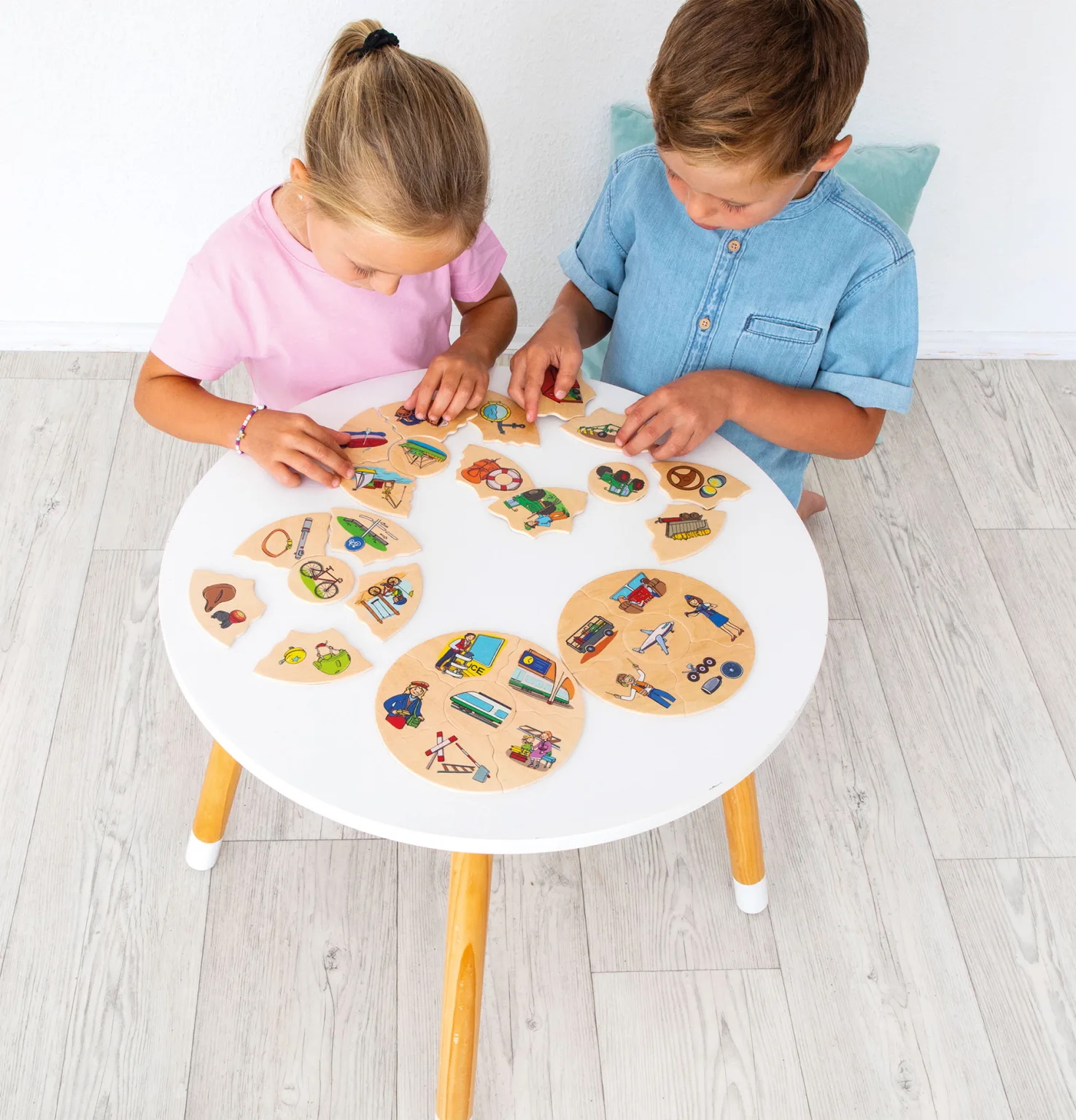
Have you ever noticed that lively children, when they are focused on playing puzzles, become particularly quiet?
When a child sits on the floor staring at colorful puzzle pieces scattered everywhere, they are actually operating their little brains at high speed!
While concentrating on the puzzle game, they enjoy every challenge that the puzzle brings!
The Four Major Benefits of Puzzles
When choosing puzzles, first confirm the benefits that puzzles bring to children. The benefits of puzzles can generally be divided into several developmental directions: cognitive development, hand-brain skills, psychological qualities, and enhancing social abilities, among others.
Puzzles and Cognitive Development
Based on neuroscience and cognitive psychology research, puzzles have core benefits for children's cognitive development, understanding how puzzles systematically construct the neural networks in children's brains. When children play with puzzles, their little brains start to work to solve the puzzle in front of them using feature elimination, pattern recognition, and systematic classification. In the process, they learn to recognize that a pattern with red corners must be a part of a fire truck! Or that the cloud piece must connect with the blue sky piece!
Classifying and integrating by color/tone/texture/shape trains their attention to detail and logical thinking and analytical skills.
Puzzles can also be the best teaching tools, such as the Little World Puzzle , which helps children understand our beautiful Earth! It helps children explore continents, countries, and their related knowledge about residents and geography. Nature Growth Process Matching Puzzles with a nature theme, each puzzle piece printed with ecological understanding of natural phenomena, allowing children to learn new vocabulary and knowledge from it. Body Layered Puzzles allow children to learn about body structure through playful learning, and it is a very fun gaming experience!
Hand-Eye-Brain Skill Coordination
During the puzzle process, it simultaneously trains the left brain's logical classification, the right hand's detail piecing, and the overall composition imagination. It cultivates children's cognitive ability towards images and pattern recognition skills, organizing puzzle patterns with dual clues of shape + color, such as connecting the colors of flowers with the aesthetic lines of flowers. Puzzles can train attention to detail and hand-eye-brain coordination.
When children transfer puzzle logic to math problems, they quickly understand application problems in their minds. This is due to organizational and problem-solving abilities, categorizing related pieces by color and content, processing them step by step, for example: first assembling the four corners and the outer frame, then the other parts, and being able to check for correctness and change to other pieces or methods when necessary.
Training Psychological Qualities
Children can learn emotional regulation through repeated trials.
A Yale study found that children who do puzzles more than twice a week have a 27% lower anxiety level in frustrating situations than usual. This is because, during puzzle-solving, the activity in the prefrontal cortex increases, and when completing the puzzle, the brain releases endorphins to enhance the experience of success.
Don't underestimate a small puzzle piece; puzzles can enhance confidence and regulate emotions.
Enhancing Social Abilities
Puzzles are also a great medium for communication, facilitating teamwork and parent-child activity time.
In the game, rules such as "taking turns" can be established for children to follow, adopting the viewpoints and suggestions of peers, expressing their own thoughts, and they can also assign roles: "You find the corners, and I'll handle the animal parts!" This trains leadership or execution abilities.